The World TodayArticle 01 of 12
The World Was Already Burning
The danger was not one war, one disaster or one failed institution. It was how many warnings the world had learned to live with.
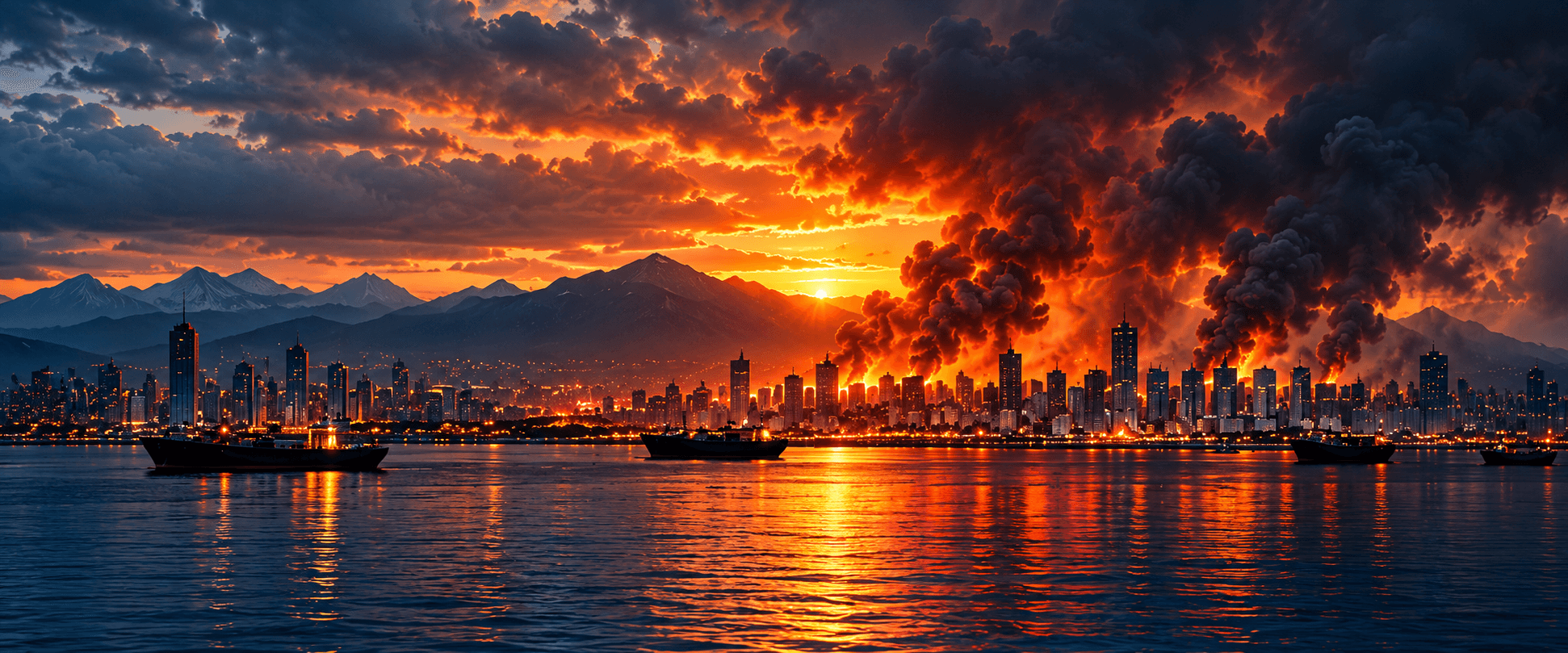
AI-generated illustration. Not a photograph of a real event.
In September 2026, the United Nations verified at least 328 civilians killed and 2,105 injured in Ukraine. It was the deadliest September for civilians since Russia’s full-scale invasion began in 2022. Missiles and drones accounted for more than half of those casualties. In Kyiv, the UN recorded civilian casualties on 22 of the month’s 30 days. Source 1
Twenty-two days in a single month. Not twenty-two days of fighting somewhere beyond the horizon, but twenty-two days on which ordinary life in a capital city was punctured by death or injury. For people living beneath the threat of attack, the world’s attention could shift elsewhere; the danger did not.
And attention was shifting elsewhere, because elsewhere was burning too.
Across continents, violence took different forms and answered to different histories. In Sudan, rival armed forces fought for control while civilians faced displacement and hunger. In Myanmar, civil war continued to fracture communities. In Haiti, armed groups undermined the state’s ability to protect its population. In Gaza and the West Bank, civilians lived with the consequences of prolonged conflict, displacement and insecurity. These were not interchangeable wars, and treating them as one would conceal the very different choices and responsibilities behind each. But together they revealed how many societies were already carrying extraordinary burdens.
The conflict-monitoring organization ACLED placed Palestine, Myanmar, Syria, Mexico, Nigeria, Ecuador, Brazil, Haiti, Sudan and Pakistan among the most severe conflict environments in its annual index. The index draws on a reporting period ending in 2025, so it is a baseline for the conditions confronting 2026—not a count of this year’s events. Source 2 What matters is the breadth of the strain: no single ceasefire, election or negotiation could resolve emergencies spread across so many regions.
War rarely stays inside the borders drawn around it on a map. It moves through fuel prices and freight routes, through families forced to leave, through budgets redirected from schools and hospitals toward immediate survival. And when it meets drought, damaged infrastructure or a weakened government, the consequences multiply.
That was already visible in the global food system. In June, the Food and Agriculture Organization and World Food Programme warned that acute food insecurity could worsen in 13 hotspots during the following months. Sudan, South Sudan, Yemen and Palestine were among the gravest concerns. Source 3 The warning did not mean the planet had run out of food. It meant that for millions of people, the distance between available food and an actual meal had become a battlefield of its own: blocked roads, unaffordable prices, lost incomes, disrupted harvests and aid that could not reliably arrive.
The same fragility reaches well beyond food. Modern societies depend on long chains of cooperation that are mostly invisible when they work: a port opens, a payment clears, a truck arrives, a power station stays online, a hospital receives supplies. Break one link and the damage may be local. Break several at once, especially during a conflict or natural disaster, and a crisis can spread into places where no shot has been fired.
Above this increasingly strained world stood a further danger: the weapons capable of turning miscalculation into catastrophe. SIPRI estimated that nine nuclear-armed states possessed roughly 12,187 nuclear warheads at the start of 2026. That figure includes weapons in different states of readiness; it is not a count of missiles poised to launch. Source 4 But the inventory is a reminder of the scale of destruction that remains possible while governments compete, threaten, arm and test one another’s resolve.
The danger is not that every regional war will become a world war. It is that international crises do not arrive politely, one at a time, waiting for the previous emergency to be solved. A confrontation at sea could coincide with an energy shock. A failed harvest could strike a country already overwhelmed by displaced families. A cyberattack could disable services during a flood. Each event would have its own causes. Their consequences, however, could collide.
That collision is the subject of this investigation. Not a claim that the end is inevitable. Not a catalogue of horrors assembled to frighten. A close look at the decisions, dependencies and failures that can turn separate emergencies into something larger—and at the cost of assuming that someone else will always contain the next one.
By October 2026, the warning signs were not hidden. They were visible in casualty reports, humanitarian appeals, conflict maps and the language of military deterrence. The harder question was whether visibility still meant urgency. A world can become accustomed to almost anything, even suffering on a staggering scale, provided it happens far enough away or slowly enough to seem normal.
Perhaps that is how a dangerous era begins: not when people fail to see the flames, but when they decide the fire is someone else’s responsibility.
Sources and reporting notes
Reporting cutoff: 25 October 2026. The annual ACLED index describes a prior reporting period; nuclear inventory figures are estimates. These sources support the attributed figures, not a prediction of global collapse.
Source links open in a new tab.
- 1
UN Human Rights Monitoring Mission in Ukraine, Protection of Civilians in Armed Conflict (September 2026)
- 2
ACLED, Conflict Index and methodology; annual ranking based on the preceding reporting period.
https://acleddata.com/series/acled-conflict-index (opens in a new tab)
- 3
FAO/WFP, New report warns worsening hunger puts 13 hotspots at significant risk
- 4